News › Guangzhou · Oncology
Guangzhou United Family Brings Beizray — a Tween-80-Free Docetaxel — to Cancer Patients
Published 9 Sep 2026 · 6-min read · Guangzhou oncology · Chemotherapy innovation

Through the Greater Bay Area’s HK–Macau Drugs & Devices (港澳药械通) channel, Guangzhou United Family Hospital is now offering Beizray® — a novel, albumin-bound, Tween-80-free formulation of docetaxel — to patients with breast, lung, head-and-neck, gastric, prostate, gynecologic and other solid tumors. The hospital’s oncology team points to a clinical record that is, in two distinct ways, “better than traditional docetaxel” — markedly lower haematological toxicity and no need for steroid pre-medication.
Why chemotherapy remains the backbone
Even in the era of targeted therapy, immunotherapy and antibody-drug conjugates, chemotherapy remains indispensable. It has unmatched broad-spectrum coverage — vital for patients without an actionable driver mutation — and spans the entire treatment journey, from neoadjuvant and adjuvant therapy to advanced palliative care. It also pairs well with newer modalities: chemotherapy + targeted, chemotherapy + immunotherapy and chemotherapy + ADCs frequently deliver stronger combination outcomes than any single modality alone.
A 60-year foundation: docetaxel’s evolution
Docetaxel — the second-generation taxane — was first isolated from European yew needles by the team of Pierre Potier in 1980, patented in 1986 and launched by Sanofi as Taxotere® in 1995. It is now used in 90+ countries and recommended by every major oncology guideline (NCCN, CSCO, CACA) across breast cancer (early neoadjuvant, adjuvant, first-line and beyond), non-small-cell lung cancer (with cisplatin as first-line for non-squamous; maintenance; chemo-radiation for locally advanced), head-and-neck (induction, first and second line), prostate (metastatic castration-resistant mCRPC; metastatic castration-sensitive mCSPC), gastric / GEJ (neoadjuvant, first and second line), ovarian / cervical / endometrial, esophageal, SCLC, bladder, and soft-tissue sarcoma.
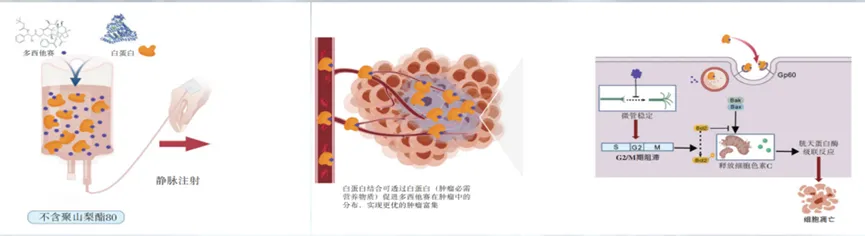
Visual: NCCN / CSCO / CACA guidelines for docetaxel — breast cancer, NSCLC, head-and-neck, prostate, gastric / GEJ, gynecologic tumors, esophageal, SCLC, bladder, soft-tissue sarcoma.
The “Achilles heel” of traditional docetaxel
Docetaxel is poorly water-soluble, so traditional formulations use polysorbate 80 (Tween-80) as a solubiliser. This creates two persistent clinical problems:
- Tween-80 is a strong allergen and can trigger severe hypersensitivity reactions — requiring all patients to undergo heavy steroid pre-medication.
- Tween-80 also competes with docetaxel for albumin-binding sites in the blood, raising free drug concentrations and increasing bone-marrow suppression.
- The required pre-medication steroids bring further glucose-fluctuation risks for diabetic patients.
These drawbacks limit the use of traditional docetaxel in elderly or frail patients. Until now, China has had no approved Tween-80-free docetaxel available — leaving a meaningful unmet need for patients who are allergic to Tween-80 or cannot tolerate steroid pre-medication.
How Beizray works: albumin, not Tween-80
Beizray binds docetaxel to natural human serum albumin in a single-molecule, non-covalent complex smaller than 1 nm. This approach sidesteps Tween-80 entirely and gives the drug a fundamentally different pharmacokinetic profile:
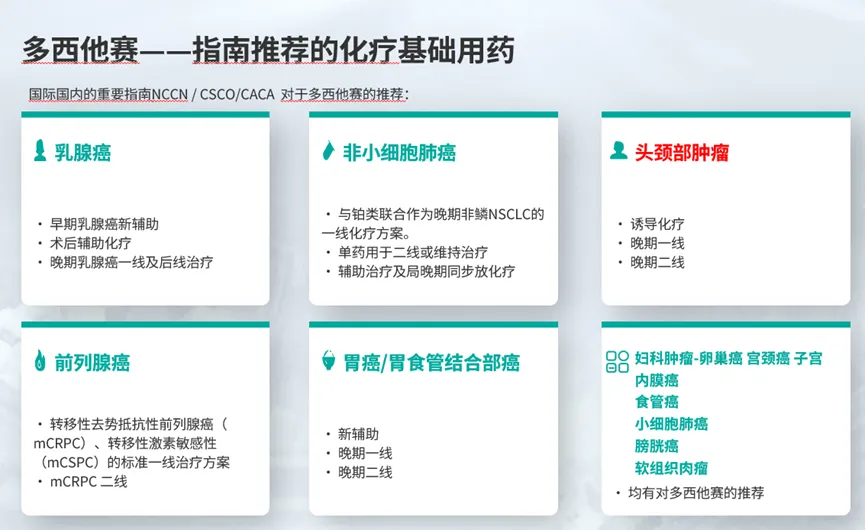
- Circulation. Docetaxel pre-binds albumin before infusion, lowering free-drug levels in plasma — reducing non-tumor toxicity.
- Tumour targeting. The albumin–docetaxel complex uses the GP60–SPARC pathway to concentrate docetaxel in tumour tissue — substantially improving tumour exposure while sparing haematopoietic cells.
- Drug release. Once inside tumour cells, docetaxel fully inhibits microtubule disassembly, arresting tumour cells in the G2/M phase and triggering apoptosis.
Regulatory status. Beizray holds FDA approval and Macau approval, has received an independent US Medicare billing code, and is protected by 21 patents across multiple countries (including a core patent on the docetaxel & human-serum-albumin solid composition and its manufacturing method).
Clinical evidence: Phase I and bioequivalence
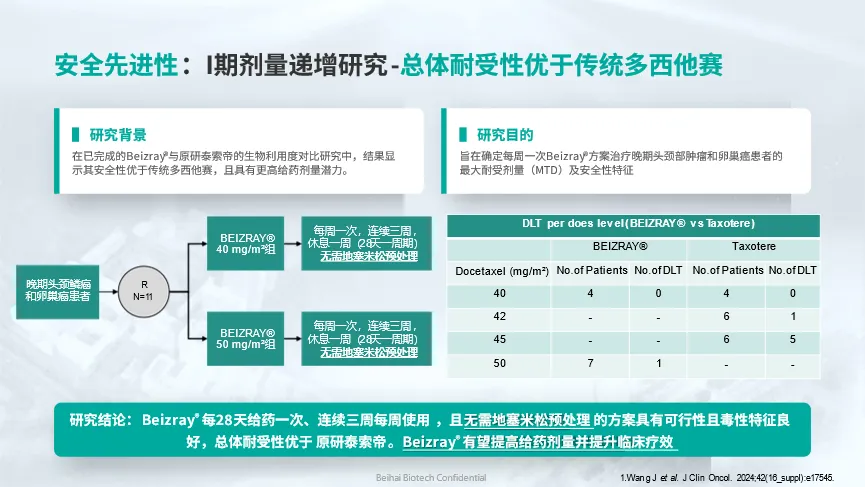
Phase I dose-escalation (Wang J et al., J Clin Oncol 2024;42(16_suppl):e17545)
A study in late-stage head-and-neck squamous-cell carcinoma and ovarian cancer patients (N = 11) who could not tolerate weekly traditional docetaxel established that Beizray every 4 weeks, without steroid pre-medication, was feasible — with a maximum tolerated dose (MTD) and overall tolerability that were both better than the traditional comparator.
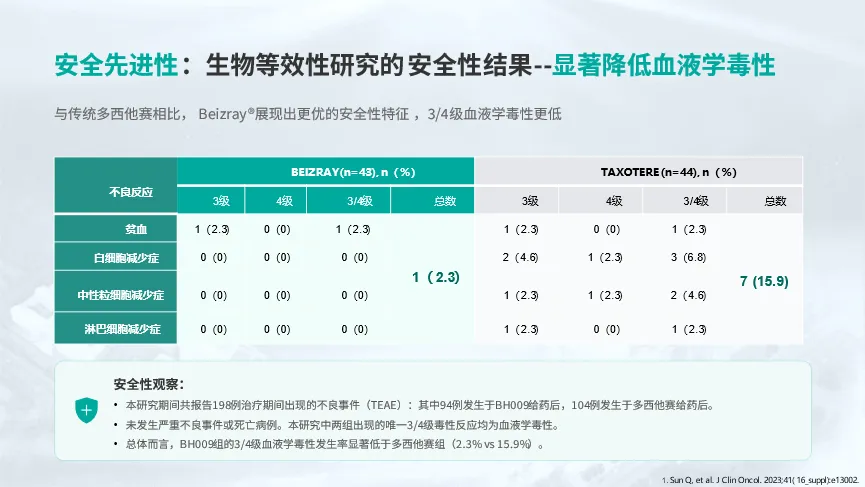
Bioequivalence (Sun Q et al., J Clin Oncol 2023;41(16_suppl):e13002)
A 41-patient, multi-centre, open-label, randomised, single-dose, two-way crossover BE study confirmed that, at the same dose, Beizray is bioequivalent to Taxotere — comparable Cmax, AUC0–t, and AUC0–inf for both total and free docetaxel. The two key safety advantages emerged in the same trial:
Bioequivalent at the same dose
Total docetaxel Cmax 3,997 vs 3,933 ng/mL; free docetaxel Cmax 756.6 vs 798.8 ng/mL — comparable within bioequivalence margins.
Grade 3/4 haematological toxicity
Beizray 2.3% vs Taxotere 15.9% — a nearly seven-fold reduction in neutropenia-driven cytopenias.
Why this matters for patients
- No Tween-80, no box warning. The albumin vehicle removes the heavy steroid pre-medication regimen and its glucocorticoid-related side effects — a meaningful change for diabetic patients or those managing active infection.
- Less bone-marrow suppression. Grade 3/4 cytopenias drop from ~16% to ~2%, meaning fewer dose delays, transfusions or growth-factor rescues.
- Higher tolerable doses → better efficacy. Improved tolerability supports more consistent dose intensity and prolonged treatment continuity.
- Fills a regulatory gap. Beizray is the first multi-cancer Tween-80-free docetaxel option accessible in mainland China (via the HK–Macau channel) — including head-and-neck squamous-cell carcinoma, where no docetaxel formulation had previously been approved.
Access via the HK–Macau Drugs & Devices channel
As a designated institution under 港澳药械通, Guangzhou United Family Hospital can introduce Beizray ahead of mainstream national approval. Guangzhou UFH’s oncology department — known among its peers for an ongoing “top drug + full journey” model — has used the policy to bring multiple breakthrough international oncology drugs to patients ahead of broader market availability.
For international patients. Bringing a novel oncology drug across borders requires careful coordination — from pathology and imaging review to logistics, pharmacy navigation and follow-up. MedTourChina’s care team can arrange a remote second opinion with UFH oncology before travel, and a dedicated coordinator can support your stay in Guangzhou.
Source: Guangzhou United Family Hospital WeChat article, 7 Sep 2026. References: Wang J et al., J Clin Oncol 2024;42(16_suppl):e17545; Sun Q et al., J Clin Oncol 2023;41(16_suppl):e13002.